
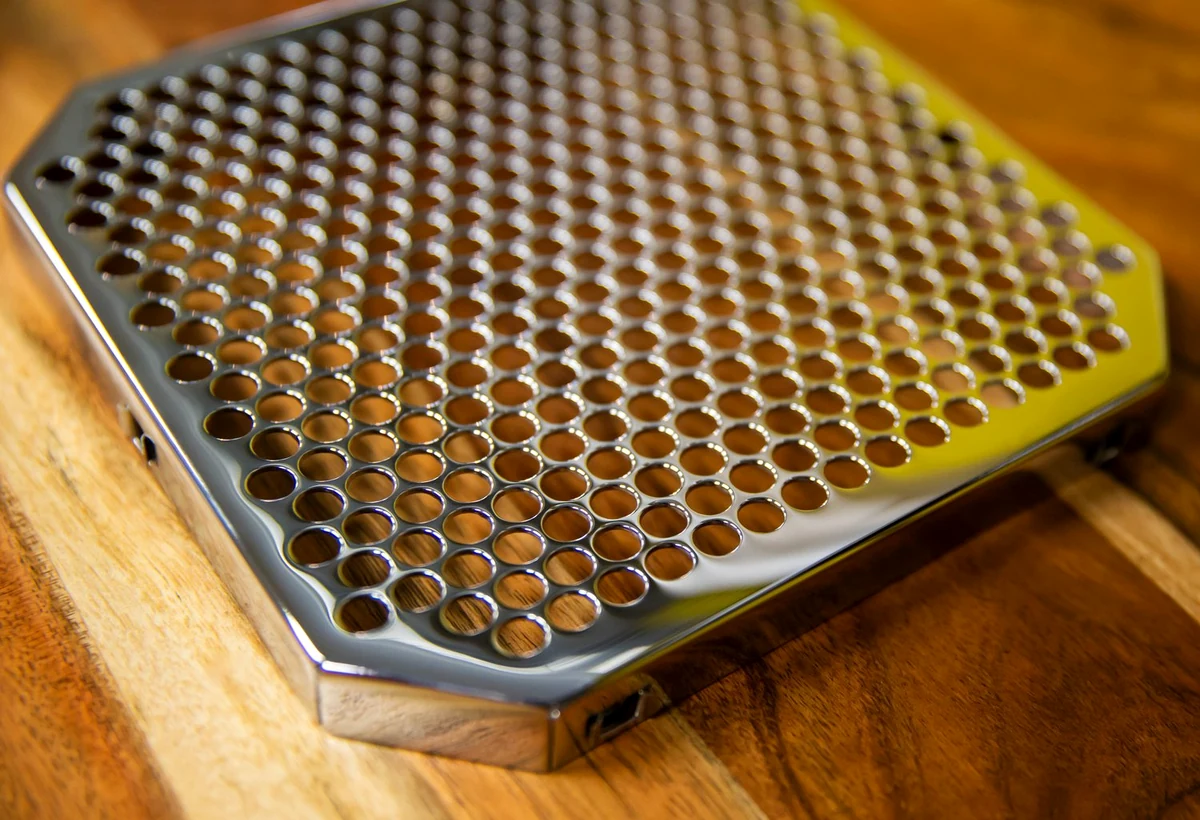
Grille material affects far more than appearance. It changes acoustic opening, stiffness, impact behavior, cabinet attachment, tooling investment, finish options, corrosion protection, and replacement strategy. The right choice depends on the product architecture and production volume, not a universal preference for metal or plastic.
01
Start with acoustic opening and protection
Perforated metal provides a predictable round-hole or slot pattern and can protect a large driver area with relatively thin material. The useful comparison is not only percentage open area; bridge width, sheet thickness, formed depth, foam, and distance from the cone influence airflow, stiffness, and noise risk.
Molded plastic can integrate ribs, logos, clips, local thickness, and complex contour. Those features may support styling and assembly, but the opening pattern must still avoid weak sections, molding defects, and acoustic restriction. Both routes should be validated in the final cabinet rather than judged from a flat sample.
- Define target open area
- Check peak cone excursion clearance
- Evaluate grille and foam together
02
Compare impact, vibration, and environment
Touring and portable products often favor formed steel because it resists knocks and can be repaired or replaced. Installation and outdoor products require careful attention to coating system, cut edges, drainage, galvanic contact, and salt or moisture exposure. Aluminum reduces mass and corrosion risk but changes stiffness and cost.
Plastic grilles avoid metal corrosion and may resist small cosmetic dents, yet polymer selection must account for UV, heat, creep, flame requirements, and impact at service temperature. Snap features and screw bosses also need repeated vibration and service review.
- Identify handling and impact scenario
- State indoor, outdoor, and chemical exposure
- Review attachment under vibration
03
Account for tooling and product volume
Metal grilles can often start with lower tooling investment using perforation, laser cutting, press-brake forming, rolling, and simple forming fixtures. Unit cost is influenced by material yield, hole process, forming complexity, edge treatment, welding, foam, and coating.
Plastic grilles require mold investment but can consolidate multiple features and reduce secondary assembly at volume. The business case should include tool maintenance, resin variation, cycle time, scrap, cosmetic approval, and future design changes, not only the first unit-price comparison.
- Prototype the attachment and profile
- Model total assembly cost
- Consider future service and revision risk
04
Write a grille specification suppliers can repeat
A strong specification defines material grade, gauge or resin, opening pattern, critical envelope, attachment datums, edge condition, finish, color and gloss, foam type, adhesive method, cosmetic zones, and packaging. For metal, coating build can change fit at return edges and fastener interfaces.
Inspection should include profile or fit, hole consistency, burr and sharp-edge control, coating appearance, adhesion requirements where specified, foam position, and packing protection. Acoustic validation belongs to the speaker manufacturer, while the supplier should provide repeatable dimensional and appearance evidence.
- Approved CAD and drawing
- Appearance and color sample
- Fit fixture or cabinet check
RFQ
Information to send with the drawing
- Cabinet opening and attachment details
- Open-area or acoustic target
- Impact and environmental requirements
- Expected annual volume
- Finish, foam, appearance, and packaging standard
Engineering responsibility
This guide describes manufacturing considerations, not a product certification or universal specification. Acoustic, structural, thermal, electrical, safety, and regulatory validation remain project-specific and must be approved by the responsible product team.